Construction Site Safety & Utility Locating | On The Mark Locators
Construction projects involve multiple activities, including excavation, drilling, material handling, equipment operation, electrical installation, and structural development. Although these activities are necessary to complete a project successfully, they also introduce potential hazards that can affect workers, contractors, nearby properties, and the surrounding community.
A construction site can become dangerous when safety procedures are overlooked, equipment is not properly maintained, workers lack adequate training, or underground infrastructure is not identified before excavation begins. Even a relatively small mistake, such as striking a buried electrical cable or water line, can lead to serious injuries, expensive repairs, and unexpected project delays.
Construction safety should therefore be treated as an essential part of project planning rather than something addressed only after work begins.
One area that deserves particular attention is underground utility protection. Buried infrastructure is not always visible, and available construction drawings may not show every utility installed beneath a property. Working with a professional utility line locator, using advanced gpr scanning, and arranging appropriate private utility locating services can help construction teams understand underground conditions before disturbing the ground.
At On The Mark Locators, we understand how important underground utility awareness is to construction safety. Our advanced locating technologies and professional subsurface investigation services help engineers, contractors, property owners, and municipalities make informed decisions before excavation.
In this guide, we will explore practical ways to improve construction site safety, prevent underground utility damage, and create a more organized working environment.
1. Conduct a Thorough Site Assessment Before Construction Begins
Every construction project should begin with a detailed site assessment. Before workers, materials, and heavy equipment arrive, project managers should understand the physical conditions of the property and identify potential hazards.
A site assessment helps establish a clear picture of the working environment and allows supervisors to develop appropriate safety procedures.
Important areas to evaluate include:
Existing buildings and nearby structures.
Soil conditions and ground stability.
Underground utilities and drainage systems.
Electrical installations and overhead power lines.
Equipment access and vehicle movement.
Pedestrian traffic and surrounding properties.
Environmental conditions and weather-related risks.
Emergency access and evacuation routes.
Underground infrastructure deserves special attention because buried utilities cannot always be identified through visual inspection alone.
Old construction drawings may be incomplete, and some privately installed utilities may not appear in public records.
Professional utility locating helps investigate these hidden conditions before excavation begins.
At On The Mark Locators, our locating quality process starts with a site walk and visual inspection. Technicians examine surface features and relevant building areas to identify potential utility indicators within the project scope.
This initial assessment helps establish a more informed starting point for the investigation.
2. Identify Underground Utilities Before Excavation
One of the most important construction safety practices is identifying underground utilities before digging, trenching, drilling, or performing other ground-disturbing activities.
Underground infrastructure may include:
Electrical cables and conduits.
Natural gas pipelines.
Water distribution lines.
Sanitary sewer systems.
Stormwater drainage pipes.
Telecommunications cables.
Fiber-optic installations.
Industrial process piping.
Accidentally damaging any of these systems can create serious consequences.
For example, striking an underground electrical cable can expose workers to electrical hazards. Damaging a gas pipeline can create a dangerous leak, while breaking a water line may result in flooding, property damage, and construction interruptions.
In the United States, contractors should contact 811 before digging, following applicable state requirements and notification timelines. However, public one-call locating programs generally cover participating utility owners' infrastructure and may not identify every privately owned installation.
This is why additional investigation may be necessary.
A professional utility line locator uses specialized equipment to trace detectable underground infrastructure and identify potential utility conflicts.
At On The Mark Locators, electromagnetic locating and other detection methods help investigate known and unknown underground utilities before construction activities begin.
3. Use GPR Scanning to Investigate Hidden Underground Hazards
Traditional utility locating methods are valuable, but some underground infrastructure can be difficult to detect using electromagnetic equipment alone.
For example, certain non-metallic pipes, plastic conduits, and undocumented installations may not produce a detectable electromagnetic signal.
Ground Penetrating Radar (GPR) provides another way to investigate underground conditions.
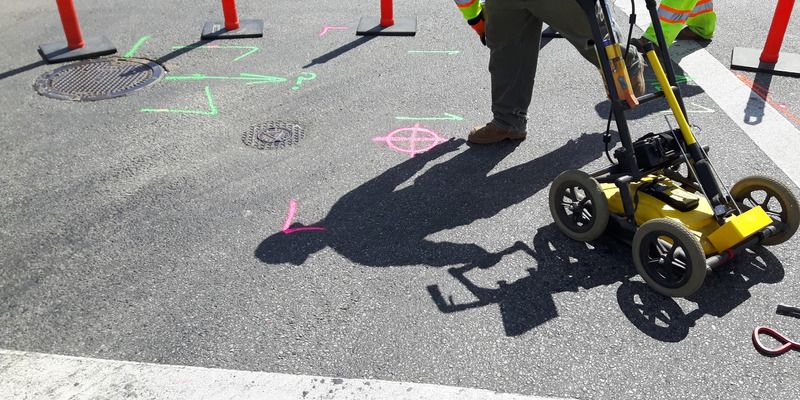
GPR equipment sends electromagnetic signals into the ground and records reflections from buried objects and changes in subsurface materials. Trained technicians interpret these signals to identify potential underground features.
What Can GPR Scanning Help Detect?
Depending on soil conditions, target characteristics, depth, and equipment, gpr scanning may help identify:
Non-metallic underground pipes.
Buried water and sewer infrastructure.
Storm drainage systems.
Fiber-optic utility routes.
Underground structures.
Subsurface anomalies and potential voids.
Other buried objects within the scanning area.
GPR is particularly useful when traditional locating methods do not provide enough information about underground conditions.
Why Does This Matter for Construction Safety?
Imagine a contractor preparing to drill through a paved commercial property.
The available utility drawings show electrical and water lines, but an undocumented drainage pipe may also be present.
Without additional investigation, the contractor may encounter that pipe during drilling.
GPR scanning can provide additional subsurface information that helps identify potential conflicts before excavation.
However, GPR does not guarantee detection of every buried object. Soil composition, moisture, depth, target size, and other site conditions can affect performance.
Using experienced technicians and combining GPR with other locating technologies helps create a more comprehensive investigation.
4. Invest in Professional Private Utility Locating Services
Public utility locating is an important first step, but it may not provide a complete picture of privately owned underground infrastructure.
Commercial properties, industrial facilities, residential developments, university campuses, and municipal sites can contain additional underground installations that are not covered by public utility marking programs.
These may include private electrical distribution lines, water connections, irrigation systems, communication conduits, drainage infrastructure, and industrial piping.
Professional private utility locating services help investigate these additional underground systems.
Who Can Benefit From Private Utility Locating?
These services can be particularly valuable for:
General contractors.
Civil and structural engineers.
Property owners and developers.
Industrial facility managers.
Utility providers and operators.
Municipal and government agencies.
Infrastructure planners.
Before construction begins, private utility locating helps project teams understand what may be present beneath their work areas.
On The Mark Locators provides private utility locating services throughout Maryland, Pennsylvania, Delaware, New Jersey, Washington, DC, and Virginia.
Our team uses electromagnetic locating and advanced detection technologies to investigate underground utilities and help clients reduce the risk of accidental damage.
5. Provide Regular Safety Training for Construction Workers
Technology and equipment alone cannot create a safe construction environment. Workers must understand potential hazards and know how to perform their responsibilities safely.
Regular safety training helps employees recognize risks, follow established procedures, and respond appropriately when unexpected situations occur.
Training should be relevant to the activities being performed at the jobsite.
Important training topics include:
Excavation and trenching safety.
Proper equipment operation.
Electrical hazard awareness.
Fall prevention and protection.
Personal protective equipment requirements.
Material handling procedures.
Hazardous substance awareness.
Emergency response procedures.
Safe movement around heavy machinery.
Training should also address site-specific conditions.
For example, workers involved in underground utility installation should understand utility markings, excavation tolerance zones, safe digging procedures, and the importance of reporting unexpected underground discoveries.
Construction supervisors should maintain appropriate training records and provide refresher instruction when jobsite conditions or work responsibilities change.
A knowledgeable workforce is better prepared to identify potential problems before they become serious incidents.
6. Make Personal Protective Equipment a Daily Priority
Personal Protective Equipment (PPE) helps protect workers from hazards that cannot always be eliminated through other safety controls.
However, simply providing safety equipment is not enough. Employers must ensure that workers understand when and how to use it correctly.
Depending on the project and identified hazards, common PPE may include:
Hard hats.
Safety glasses or goggles.
High-visibility clothing.
Protective gloves.
Appropriate safety footwear.
Hearing protection.
Respiratory protection.
Fall protection equipment.
PPE requirements should be determined through an appropriate hazard assessment.
For example, workers operating near moving construction equipment may require high-visibility clothing, while those performing certain cutting or drilling activities may need eye, hearing, or respiratory protection.
Supervisors should regularly inspect equipment for damage and replace items that no longer provide adequate protection.
Proper storage and maintenance are also important.
A consistent PPE program helps reinforce the idea that worker protection is a daily responsibility rather than an occasional requirement.
7. Follow Proper Excavation and Trenching Safety Procedures
Excavation is one of the most hazardous activities in construction. Workers may face cave-ins, falling materials, equipment-related injuries, hazardous atmospheres, and accidental contact with underground utilities.
A safe excavation process requires careful planning before workers enter or approach an excavation area.
Evaluate Soil Conditions
Different soil types have different stability characteristics. Contractors should have a competent person evaluate soil conditions and determine the appropriate protective system.
Use Appropriate Protective Systems
Depending on excavation conditions, protective systems may include:
Sloping.
Benching.
Shoring.
Shielding.
These methods help reduce the risk of cave-ins and protect workers inside excavations.
Provide Safe Access and Exit
Workers need appropriate access and exit arrangements. OSHA generally requires safe means of egress in trenches that are 4 feet or deeper, with no more than 25 feet of lateral travel.
Inspect Excavations Regularly
A competent person should inspect excavations before work begins, throughout the workday as needed, and after events that could increase hazards.
Keep Equipment and Materials Away From Edges
Heavy equipment, excavated soil, and construction materials should be positioned appropriately to reduce the risk of falling materials and additional pressure on excavation walls.
Identify Underground Utilities
Before excavation begins, contractors must determine the estimated location of underground installations and coordinate with utility owners or operators as required.
At On The Mark Locators, our utility locating solutions help construction teams identify potential underground conflicts before excavation activities begin.
Proper utility detection combined with OSHA-compliant excavation procedures provides an important foundation for safer construction work.
8. Inspect Construction Equipment and Machinery Regularly
Construction equipment plays a major role in project productivity, but poorly maintained machinery can create significant safety risks.
Equipment failures may lead to mechanical accidents, struck-by incidents, unexpected movement, or loss of operational control.
Regular inspections help identify potential problems before equipment is used.
Depending on the machinery, inspections may include:
Braking systems.
Tires and tracks.
Hydraulic connections.
Fluid levels.
Warning lights and alarms.
Safety guards.
Emergency shutdown systems.
Steering and control mechanisms.
Electrical connections.
Equipment operators should complete required pre-use checks and report defects immediately.
Supervisors should also maintain inspection and maintenance records to support preventive maintenance schedules.
When equipment requires repair or maintenance, appropriate lockout/tagout procedures should be followed to prevent unexpected energization or movement.
A well-maintained equipment fleet helps reduce avoidable hazards and supports more reliable project operations.
9. Establish Clear Hazard Communication and Jobsite Signage
Construction sites can contain changing hazards throughout the day. Workers need clear information about potential risks, restricted areas, emergency procedures, and required precautions.
Hazard communication helps ensure that important safety information reaches everyone involved in the project.
Effective communication methods include:
Clearly visible warning signs.
Excavation and restricted-area markings.
Equipment movement indicators.
Chemical hazard labels.
Safety Data Sheets (SDS).
Daily safety briefings.
Emergency contact information.
Site-specific safety instructions.
Communication should also account for differences in language, experience, and job responsibilities.
Visual instructions, diagrams, color-coded signs, and demonstrations can help workers understand safety requirements more effectively.
Underground utility markings are another important communication tool.
When utilities are identified in the field, markings should be clear, understandable, and protected from unnecessary disturbance.
Construction teams should communicate any changes in site conditions and report unexpected underground findings immediately.
10. Prepare an Effective Emergency Response Plan
Even well-managed construction sites can experience unexpected incidents. Having an emergency response plan helps workers understand what to do when something goes wrong.
Emergency planning should address potential situations such as:
Worker injuries.
Electrical accidents.
Gas leaks.
Fires and explosions.
Excavation collapses.
Equipment incidents.
Severe weather.
Hazardous material releases.
A practical emergency plan should identify evacuation routes, assembly locations, emergency contacts, first-aid resources, and communication procedures.
Workers should understand how to report emergencies and where to find appropriate safety equipment.
Regular drills can help employees become familiar with emergency procedures.
When an underground utility is damaged, workers should follow the applicable emergency procedures and contact the appropriate utility owner or emergency services. They should not attempt to repair hazardous utility infrastructure themselves.
Quick communication and a coordinated response can help reduce the impact of unexpected incidents.
11. Document Safety Procedures and Continuously Improve Your Process
Construction safety should be reviewed throughout the life of a project.
As construction progresses, new activities, equipment, workers, and site conditions can introduce additional hazards.
Maintaining accurate records helps project managers identify recurring issues and determine where improvements may be necessary.
Useful safety documentation may include:
Site assessment reports.
Worker training records.
Equipment inspection logs.
Hazard assessments.
Excavation inspection records.
Incident reports.
Corrective action documentation.
Utility locating and mapping information.
Underground utility documentation deserves special attention.
Accurate utility mapping can help engineers and contractors understand where identified underground infrastructure is located and plan future construction activities accordingly.
On The Mark Locators provides Utility Mapping and CAD Deliverables that transform verified subsurface information into clear documentation for engineering and construction teams.
The company also provides Subsurface Utility Engineering (SUE) services to support projects that require more detailed investigation of existing underground infrastructure.
Reviewing safety records and investigation findings helps organizations improve their procedures over time.
How On The Mark Locators Helps Create Safer Construction Environments
A safer construction site begins with understanding potential hazards before work starts.
While worker training, PPE, equipment maintenance, and excavation procedures are essential, underground utility awareness is another critical part of construction risk management.
On The Mark Locators provides professional utility locating and subsurface investigation services that help clients identify underground infrastructure before excavation and construction activities begin.
Our services include:
Private Utility Locating Services: We help identify privately owned underground infrastructure, including gas, electric, water, sewer, communication lines, storm drainage, and industrial piping.
GPR Utility Locating: Ground Penetrating Radar helps investigate potential non-metallic utilities and underground anomalies where traditional locating methods may be limited.
Subsurface Utility Engineering (SUE): Our SUE services support better design and construction decisions through structured underground utility investigation.
Utility Mapping & CAD Deliverables: We provide documentation that helps engineers and construction professionals understand identified underground infrastructure.
Utility Locating for Municipalities: We support cities, towns, and public agencies with underground utility investigation for infrastructure projects.
Concrete Scanning: Our concrete scanning services help identify embedded reinforcement and other detectable objects before cutting, coring, or drilling into concrete structures.
Our Multi-Technology Utility Locating Process
Our approach combines different technologies to investigate underground conditions:
Site Walk: Visual inspection of the work area and relevant surface features.
Known Utility Locating: Electromagnetic locating to trace accessible and identifiable utility lines.
Unknown Utility Investigation: Passive and induction scanning to investigate additional underground signals.
GPR Investigation: Ground Penetrating Radar to identify potential underground anomalies and utilities.
Quality Review: Review and documentation of findings to support a better understanding of the project site.
This approach helps engineers, contractors, infrastructure owners, and property managers make informed decisions before excavation.
Visit On The Mark Locators to explore our services or request professional utility locating support for your next construction project.
Conclusion
Construction safety requires a proactive approach that addresses potential hazards before they affect workers, equipment, or project schedules.
From conducting site assessments and providing safety training to maintaining equipment and following proper excavation procedures, every safety practice contributes to a more organized working environment.
Underground utility protection should be an equally important priority.
A professional utility line locator helps identify detectable buried infrastructure, while GPR scanning provides additional information about potential underground features that may not be easily identified through conventional locating methods. Private utility locating services are especially valuable when privately owned utilities may not be included in public locating records.
Combining these services with proper excavation planning, worker training, and accurate documentation helps construction professionals reduce uncertainty and improve jobsite safety.
At On The Mark Locators, we believe that knowing what lies beneath the surface is an essential part of responsible construction.
Before your next excavation, drilling, or infrastructure improvement project, make professional underground utility detection part of your safety planning. Partner with On The Mark Locators to help protect your workforce, reduce underground utility risks, and build with greater confidence.